

Is La Maiella worth visiting? An honest guide from someone who keeps coming back
Mar, 12th 2026
Some places you visit. Others you feel. La Maiella is the second kind.
There’s a moment, usually somewhere between the beech forests and the first clear view of the valley below, when you stop walking and just stare. The air is different up here — cooler, quieter, older. And if you know the story of this mountain, you understand why people have been coming here for thousands of years not just to hike, but to heal.
Abruzzo has two great mountain icons. The Gran Sasso — sharp, dramatic, unmistakable against the northern sky. And La Maiella — rounder, wilder, more intimate. Different in character, equal in soul. If the Gran Sasso is Abruzzo’s spine, La Maiella is its heart.
As someone who is half-Abruzzese, I’ve been coming to this mountain my whole life. With my parents, with my wife, with friends who feel like family. Each time, it gives me something different. And there’s still plenty left on my list to explore — which, honestly, makes me happy. Some places deserve to be discovered slowly.
The Legend: Why This Mountain Has a Soul
Before you visit La Maiella, you need to know her story. Because this is not just a mountain. This is a mother.
Legend says that Maja — the most beautiful of the Pleiades, celestial nymphs in Greek mythology — fled her homeland to save her only son, a great warrior who had been badly wounded in battle. An oracle had predicted that a miraculous herb growing on the mountain could save him, so she crossed the sea, shipwrecked on the Abruzzo coast near what is now Ortona, and began climbing — carrying her son in her arms.
But her son — known in the legend as Hermes, the divine messenger of the gods, here cast not as Olympian deity but as a mortal warrior — died before she could find the herb. She buried him on the mountain peak, and today, anyone looking at the Gran Sasso from the east can see the outline of a sleeping giant — a giant that still carries the memory of that loss in its silhouette.
As for Maja — overcome with grief, she wandered the mountains until she too died. Her loved ones adorned her with precious robes, gold vessels, and garlands of flowers, and buried her on the majestic mountain opposite. From that day on, the mountain bore her name: Majella.
This is why locals call La Maiella la montagna madre — the mother mountain. And once you know the story, you hear it in the wind differently.
The Sleeping Beauty of Abruzzo
La Maiella has two names that coexist beautifully. She is la montagna madre — ancient, nurturing, wild. And she is also la bella addormentata — the Sleeping Beauty — because from a distance, her silhouette traces the outline of a woman lying at rest.
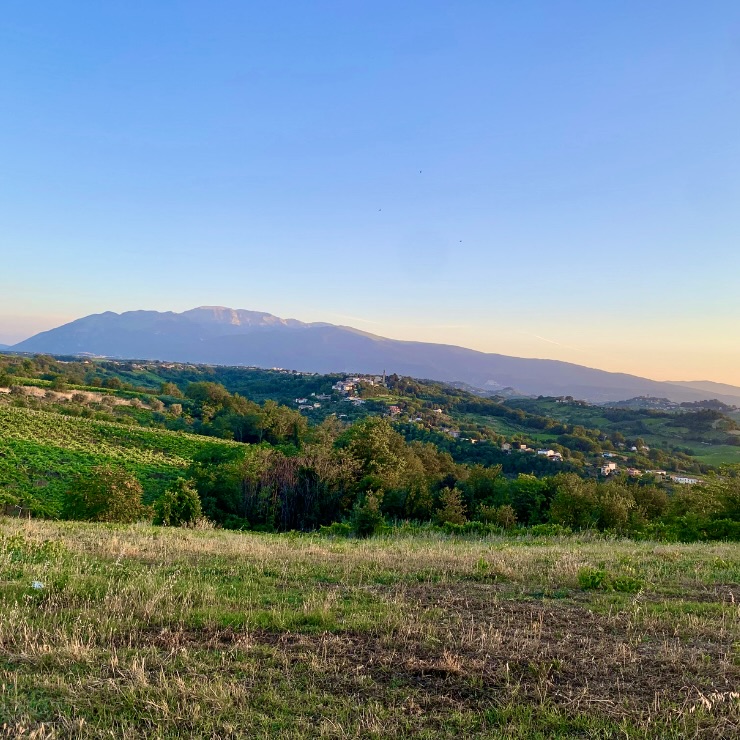
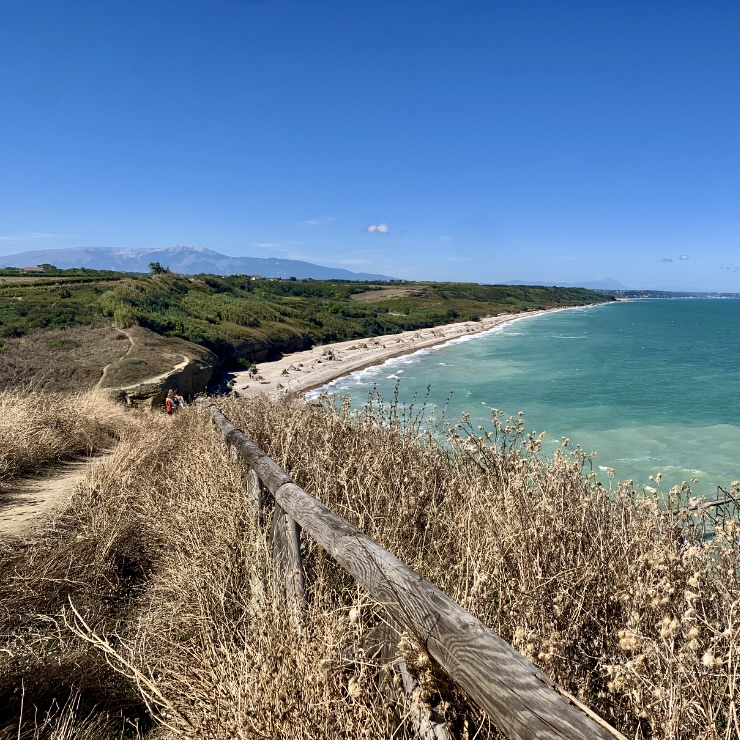
When the sky is clear, La Maiella is visible even from the Adriatic coast: round and maternal when covered with snow, glowing in the winter light; softened into a blue profile against summer sunsets.
I’ve seen her from the coast of Pescara. I’ve seen her from the hills above Guardiagrele. Every angle is different. Every angle is worth stopping for.
What Is La Maiella, Exactly?
The Maiella National Park has been a UNESCO Global Geopark since 2021. Under its wing: 74,000 hectares of breathtaking landscape, 38 municipalities, three provinces, and a remarkable biodiversity — one third of all Italy’s flora species lives here.
The highest peak is Monte Amaro at 2,793 metres — the second highest in the entire Apennine chain. Its name translates as “Mountain of Sorrow” — as if even the geography remembers Maja’s grief.
But La Maiella is not one thing. It’s forests and canyons, ski slopes and shepherds’ trails, medieval hermitages carved into cliff faces, and valleys that feel genuinely remote. I’ve only explored a part of it so far — and that part alone has already given me some of my most treasured memories in Abruzzo.
Places I Know and Would Return to Without Hesitation
Paso Lanciano / La Maielletta
This is where most people start — and for good reason.
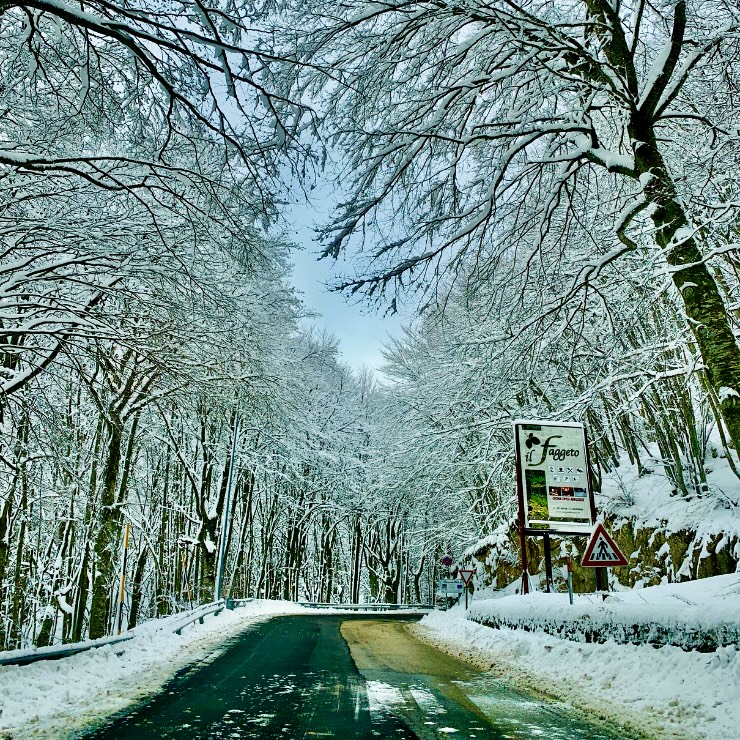
I’ve been to Paso Lanciano more times than I can count. My first clear memory is New Year’s Eve 2018, driving up with my family as the world outside the car windows turned progressively, magically white. My mother — who had never seen that much snow in her life — couldn’t stop laughing. We wandered through the snow, drank hot chocolate, and stood in silence looking at a landscape that felt borrowed from another world.
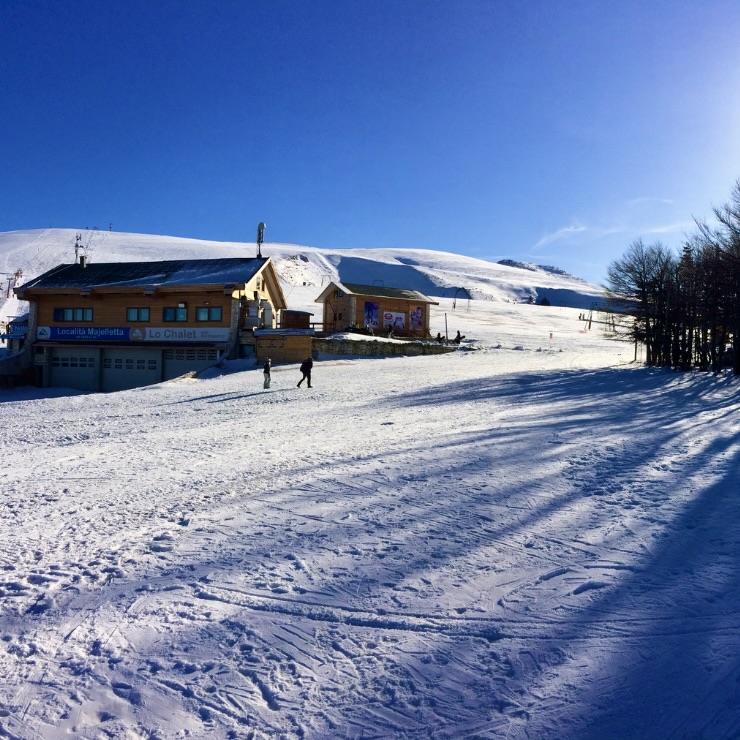
I’ve been back since — once with friends who feel more like brothers, once with my wife and parents. The ritual is always the same: hot chocolate at Paso Lanciano, then up to La Maielletta. And from the top, on a clear day, you can see the Adriatic Sea glittering in the distance. Two worlds at once: the wild mountain and the blue Mediterranean. We once rented small toboggans and came down laughing like children. I recommend it without reservation.
Pennapiedimonte and the Valle dell'Avello
This is the hidden gem of the Maiella, and almost no one outside Abruzzo knows it exists.
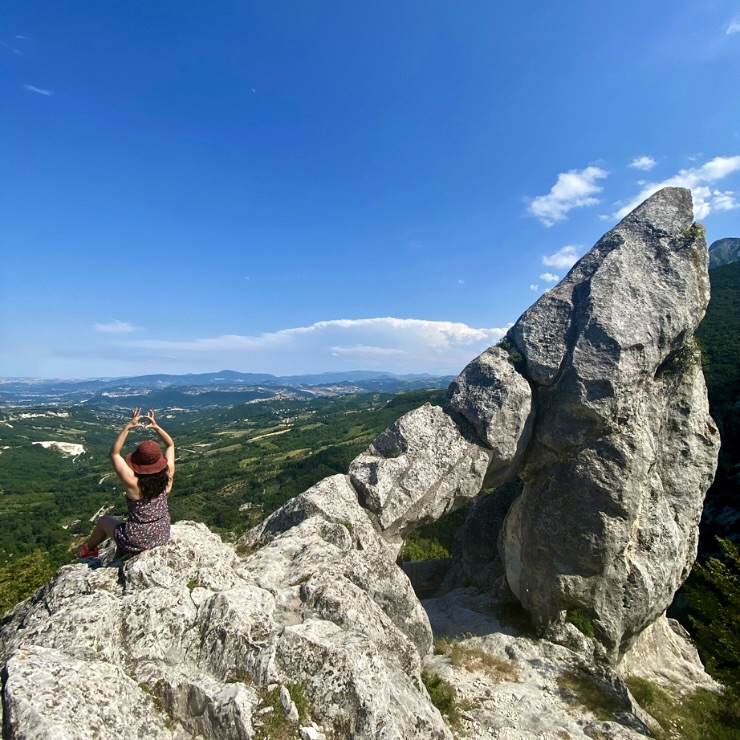
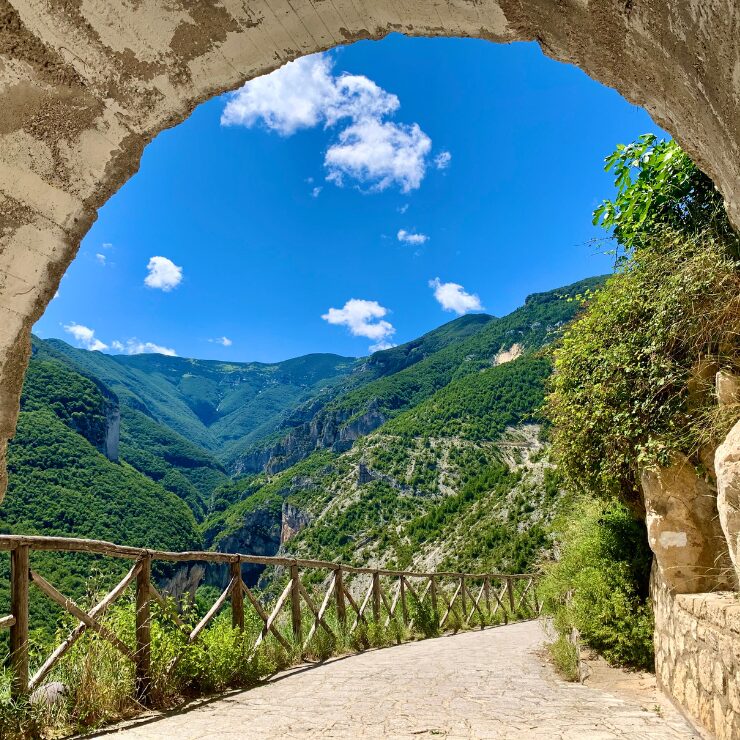
Pennapiedimonte is a village of around 400 people — stone houses carved directly into the rock of the mountain, narrow lanes, and at its peak, one of the most spectacular natural viewpoints in all of Abruzzo. The Belvedere Balzolo — known locally as il balcone d’Abruzzo, the balcony of Abruzzo — is a natural terrace suspended over the rock inside the Maiella National Park, with panoramic views stretching all the way to the Adriatic Sea. It’s the starting point for several trails into the heart of the Maiella — including the G1 and G2 routes into the gorges of the Avello, and the Gobbe di Selvaromana, where a beautiful stone arch marks the beginning of the path and the Valle dell’Avello opens up before you in all its splendour.
The trail into the Valle dell’Avello is one of the most spectacular walks I’ve ever done. We didn’t complete the whole route (time wasn’t on our side), but even the first section left us speechless: canyon walls rising on either side, the sound of the river, the forest closing in, the feeling of genuine remoteness. I’ve done this walk with my parents, with my wife, with my sister, with friends. Every time, someone stops and says “I had no idea this existed.”
Before you enter the valley, look for the Roccia della Dea Maja — a natural rock formation shaped unmistakably like a woman hunched forward, gazing into the valley. Legend says she is the Goddess Maja herself, still tending to her son. Standing in front of it, knowing the story, it stops being geology and becomes something else entirely.
Guardiagrele: The City of Stone
Guardiagrele, in the province of Chieti, sits at the foot of La Maiella and deserves more than a passing mention. Gabriele D’Annunzio — Abruzzo’s most celebrated poet — called it “la Città della Pietra”, the City of Stone, for its remarkable medieval centre built entirely from Maiella limestone. It’s known across the region for its centuries-old artisan traditions — wrought iron, copper, and goldsmithing — and for one very specific, very unmissable pastry: the sise delle monache, made at the historic bakery Emo Lullo since 1889. Sponge cake, custard, powdered sugar. Don’t leave without one.
Parco Fluviale delle Acque Vive
At the foot of the Maiella massif, near the village of Taranta Peligna, the springs known as the Acquevive emerge from the earth in a river park of striking natural beauty — their waters flowing constantly and perennially along the banks of the Aventino. The name says it all: these are living waters, rising up through the limestone rock, crossing through vegetation and stones, feeding the tributaries of the Aventino river as they descend into the valley.
One of my favourite food memories in the whole area happened here — a Ferragosto celebration in 2017 with a group of friends, eating arrosticini fresh off the grill alongside a generous spread of local cured meats and bread with olive oil. Simple, generous, completely Abruzzese. The park is well set up for visitors — picnic areas, wooden walkways along the river, and barbecue grills you can book at the entrance. It’s the kind of place that invites you to slow down and stay longer than planned.
What's Still on My List
I want to be honest with you: La Maiella is vast, and I haven’t seen all of it yet. Still on my list:
- Valle dell’Orfento — one of the park’s most dramatic canyons, carved by the Orfento river through the heart of the massif
- Caramanico Terme — one of the most beautiful villages in all of Italy, known for its thermal waters and its position deep inside the national park
- The medieval hermitages carved into the cliff faces — particularly the Eremo di Santo Spirito a Majella
- More of the villages scattered around the park that I’ve only glimpsed from a distance
That’s the thing about La Maiella. It’s not a place you can finish. Every visit opens a new door.
The Honest Verdict
Is La Maiella worth visiting? Yes. Without hesitation.
But what I really want to tell you is this: La Maiella is not the kind of place you tick off a list. It’s the kind of place that stays with you. That you come back to. That gives you something different each time.
My mother saw snow for the first time on this mountain. My wife and I have walked its valleys in silence. I’ve stood on its ridges with friends and felt something I can only describe as belonging — to this place, to these people, to this half of who I am.
That’s what La Maiella does. It reminds you where you come from, even if you’ve never been before.
FAQ
Is La Maiella worth visiting?
Absolutely. La Maiella is one of the most beautiful and least touristy corners of Italy — a UNESCO Global Geopark with ancient legends, dramatic landscapes, and an authenticity that’s increasingly hard to find. Whether you’re there for hiking, history, food, or simply to breathe mountain air, it delivers.
What is the best time to visit La Maiella?
Every season has something to offer. Spring brings wildflowers and clear trails. Summer is perfect for long hikes and Ferragosto celebrations. Autumn turns the beech forests gold. Winter transforms everything into a snow-covered landscape that feels almost sacred — and the hot chocolate at Paso Lanciano is reason enough to come in December.
What is La Maiella known for?
La Maiella is known for being Abruzzo’s montagna madre — the mother mountain — both in legend and in spirit. It’s home to the Maiella National Park, a UNESCO Global Geopark since 2021, and is famous for its hiking trails, medieval hermitages, dramatic canyons, and deep connection to Abruzzese identity and mythology.
Practical Information
- Maiella National Park: parcomajella.it
- UNESCO Global Geopark since 2021
- Nearest airports: Pescara (approx. 45 min by car), Rome Fiumicino (approx. 2.5 hrs)
- Best starting point for first-timers: Guardiagrele → Paso Lanciano